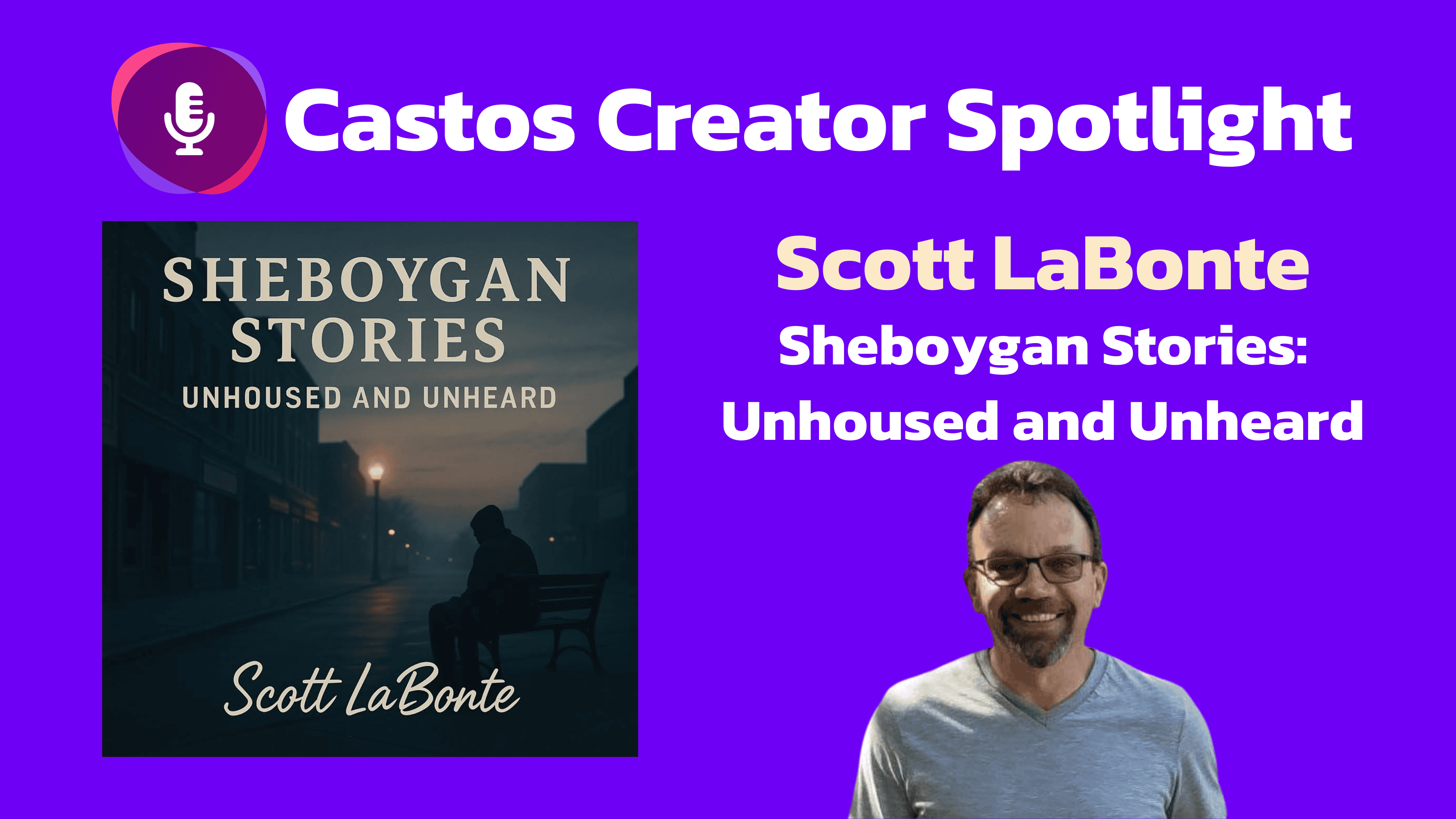
Learn how Scott LaBonte's Sheboygan Stories turns real experience into a steady supply of episode ideas, and how to copy the method for your own show.
Most advice about podcast ideas says to brainstorm topics. Scott LaBonte's show, Sheboygan Stories: Unhoused and Unheard, works differently. His ideas come from a gap he'd been staring at for years, and he keeps them coming by never closing the loop on his guests. Here's how that works and how to borrow it.
Start With the Gap You Already See
Scott and his wife Kathleen co-founded a day center for people experiencing homelessness in Sheboygan, Wisconsin, and helped more than 85 people into housing. Through that work they saw what was missing from the local conversation: the people living it were rarely the ones talking. The podcast exists to fill that hole.
That's a better idea engine than a topic list. A gap gives you a reason to exist, and every episode is another way of filling it. Scott has put out 22 episodes since June 2025 on a biweekly schedule, and the show still feels focused because each one answers the same question: whose voice is missing here?
You don't need a nonprofit behind you. You need a place where you've spent enough time to notice what the usual coverage skips. Maybe it's your trade, your town, or a hobby community. The gap is usually right next to where you already work.
- Write down three things people in your field get wrong or never hear about.
- For each one, name who is actually living it and isn't being heard.
- Pick the gap you could still talk about 30 episodes from now.
- Turn it into one sentence: "This show exists because ___ never gets heard."
Treat Guests as Ongoing Lives, Not One-Offs
The smartest move in this show is the return visit. Early on, a guest named Jimmy describes sitting at a bus stop in November with no blankets and nowhere to go. Several episodes later, Scott circles back. Jimmy has his own apartment, does his laundry, cooks, and pays rent. The before-and-after only lands because the audience heard the before.
Scott does the same with Amanda, whose episode Tent to Tenancy runs from domestic violence and sleeping on the beach through treatment to her own place. His line sums up the approach: "People aren't just moments. We're lives in motion." For idea generation, this is a gift. Every past guest is a built-in sequel, and you never have to start from zero.
People aren't just moments. We're lives in motion.
- Scott LaBonte, Sheboygan Stories
Even his solo episode The Quiet Work comes from this thinking. Once someone is housed, the progress gets invisible. As Scott puts it, you can't take a picture of "hey, I paid my rent again this month." Ask yourself what the quiet, unglamorous follow-up is in your niche. That's often the episode nobody else is making.
- List every past guest or case study you've covered.
- Mark which ones have a clear "what happened next" worth asking about.
- Add a short follow-up segment to your next three episodes.
- Keep a simple log of guest contact details and the last time you checked in.
Mix Personal Stories With Hard Numbers and Experts
If every episode were a personal testimony, the show would get heavy and repetitive. Scott varies the format. Couch Hopping Isn't Home features Shanna on the kind of homelessness people don't picture, where you bounce between couches and don't look the way people expect. Inside the System brings in a drug court coordinator and a licensed therapist to explain how addiction, mental health, and housing collide in the justice system.
Then he backs it with data. In Homelessness 101, Kathleen shares that only 25 to 35 percent of people experiencing homelessness have a substance use disorder, and that Sheboygan's vacancy rate sits around 1 to 2 percent. Those numbers challenge assumptions the stories alone might not. The personal voice makes people care, and the stats show the pattern is real.
You can use the same three-part rotation in almost any niche: a lived-experience story, an expert who explains the system, and a primer with real figures. Run them in a loop and you'll never wonder what to publish next.
Let Your Day Job Shape the Angle
Scott is a special education teacher, and it shows. In Meeting People Where They Are, he draws a line from the classroom to street outreach: "A child isn't defined by what they can't do." That teaching mindset gives the whole show a consistent lens, which is why it doesn't read as generic advocacy.
Your own background can do the same. The framework you use at work, whether it's a teacher's patience, a mechanic's diagnostic habit, or a nurse's triage thinking, can become the recurring angle that makes your episodes recognizable. Ideas get easier when you have a lens to run them through.
- Name the skill or habit from your day job that shapes how you see problems.
- Write one episode idea that applies that lens to your niche.
- Plan a rotation: one personal story, one expert, one numbers-driven primer.
- Set a cadence you can keep, like biweekly, before you plan the season.
One more thing worth noting: Scott's organization recently closed its doors, and the podcast is now carrying that mission forward, aiming to move listeners from awareness into action. A show built on a real gap and real relationships can outlast the project that started it.



Leave a
comment