Use Buffer's 14-million-post dataset to draft a starter Facebook schedule, then test it against your own audience.
If you're adding Facebook to your content mix, or dusting off an account you abandoned years ago, the first planning question is simple: when do you post? Guessing wastes weeks. Buffer analyzed more than 14 million Facebook posts from businesses, creators, and influencers, so you can start from real numbers and build a schedule around them.
One caveat first. No universal time guarantees reach. Your audience decides what works for you. Treat the data below as a starting hypothesis, not a rule.
Start with the data, not a hunch
Engagement (reactions, comments, shares) is a strong signal to Facebook's algorithm that people want your content in their feeds. Higher engagement tends to mean higher reach, so timing matters most in the first stretch after you publish.
Here's what the dataset shows. Thursday at 9 a.m. is the single best slot, with 8 a.m. and 10 a.m. on Thursday filling out the top three. Wednesday is the best day overall, with Thursday and Tuesday close behind. Wednesday and Sunday mornings also perform well.
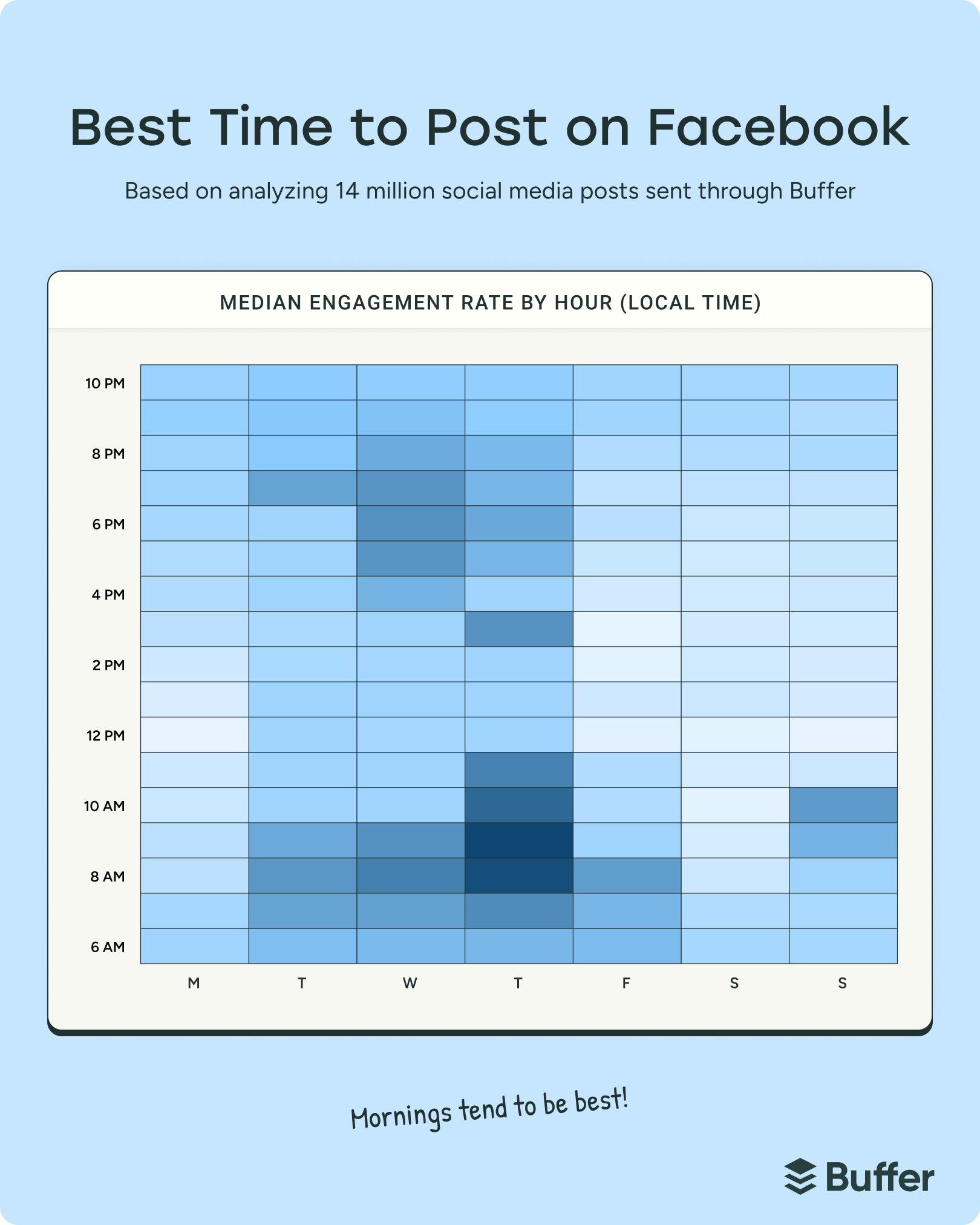
The broader pattern is a morning window. Weekday engagement tends to peak between 6 a.m. and 11 a.m. Monday is the exception, with its best slots from 7 p.m. to 10 p.m. The 12 p.m. to 5 p.m. stretch consistently shows the lowest engagement, so that's where your posts go to die.
The pattern makes sense given who's on the platform. The biggest Facebook age group is 25-34, followed closely by 35-44. Pew Research found 93% of Facebook users say keeping up with friends and family is a reason they use it. Instagram (86%) and TikTok (95%) skew toward entertainment. People check Facebook as part of a morning routine, not as a lean-back scroll session.
Draft your first two weeks of posts
Don't spread posts evenly across the week. Cluster them where the data says attention is highest, and leave the weak slots empty. Saturday is the worst day to post, and Sunday only does slightly better, though still behind weekdays. If you have limited content, skip Saturday entirely.
A reasonable starter plan is to anchor the week on Wednesday and Thursday mornings, add a Tuesday morning slot, and treat Monday evening as your one off-pattern test. If you have the content volume, try a Sunday morning post too. Keep everything out of the afternoon window until your own numbers say otherwise.
- <strong>Tuesday:</strong> one morning post between 6 and 11 a.m.
- <strong>Wednesday:</strong> your best day overall, so schedule your strongest content here in the morning.
- <strong>Thursday:</strong> the 9 a.m. anchor post, with 8 or 10 a.m. as alternates.
- <strong>Monday:</strong> an evening slot between 7 and 10 p.m.
- <strong>Sunday:</strong> optional morning post if you have spare content.
- Pick 3-5 posting slots from the high-engagement windows above
- Put your best-performing content (for example, strong Instagram posts you're crossposting) in the Wednesday and Thursday morning slots
- Leave the 12-5 p.m. window empty for the first two weeks
- Queue everything in a scheduler so timing doesn't depend on your own morning routine
Test it against your own audience
Aggregate data from millions of posts describes the average account, not yours. Your audience might be night owls, a different age group, or mostly weekend browsers. The fix is to run your schedule for a couple of weeks, then look at what actually happened.
Change one variable at a time. If you shift both the time and the content format in the same week, you won't know which one moved the numbers. Pick one slot to experiment with, such as moving a Thursday post from 9 a.m. to 8 a.m., and compare engagement against the baseline.
- Run the starter schedule for at least two weeks before judging it
- Record reactions, comments, and shares per post alongside publish time
- Flag your top three posts and check whether they share a time window
- Test one new slot per week, such as Monday evening or Sunday morning
- Replace any slot that consistently underperforms, and keep the ones that beat your average


Leave a
comment